Most patients who come to my office interested in rhinoplasty are in their twenties or thirties. When someone in their late fifties or sixties sits across from me, describing how their nose now droops, appears longer, or simply no longer matches the face they imagine, the conversation shifts entirely.
The nose does change as we age—cartilage weakens, skin thins in some areas and thickens in others, and the nasal tip often loses its projection, pointing downward. Gravity and years of subtle tissue remodeling have a significant, visible impact. The surgical approach for an aging nose is fundamentally different from that for a younger patient born with a dorsal bump or asymmetry.
My foundation in open structure rhinoplasty informs every evaluation I make—especially for the aging nose. Here, structural support isn’t just about aesthetics, but about function. A nose that droops at the tip often means some degree of nasal valve collapse, making breathing more difficult. Very often, both cosmetic and functional concerns stem from the same underlying structural issue.
The Aging Nose Loses Structure Before It Loses Shape
What surprises most patients is that the drooping they notice in the mirror is actually the end result of changes that started years earlier. The process begins as cartilage—particularly the lower lateral cartilages that define the nasal tip—steadily weakens, losing the ability to withstand gravity and support the weight of the overlying skin. The septum, the central support column of the nose, may also bow or weaken with age, causing both visible deformity and internal breathing obstruction.
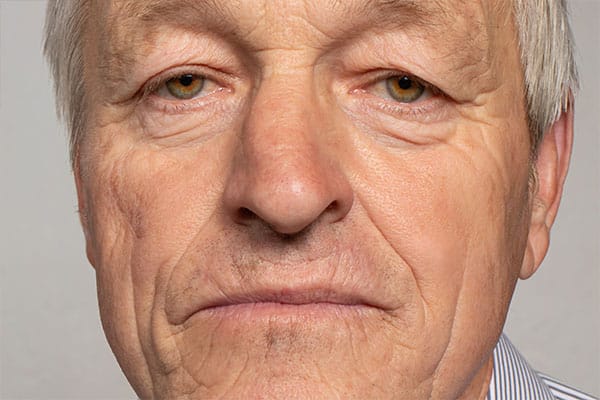
This is a common pattern in my Miami practice: a patient points to the tip, frustrated that it hangs too low, but upon examination, it’s clear that the entire cartilage framework has shifted. The nasal bones and dorsum may look unchanged, but the lower third—the area that usually ages most dramatically—has lost much of its original support.
Surgical planning, therefore, must focus on rebuilding support, not simply reshaping. In younger patients with strong native cartilage, I can often reposition or conservatively trim the existing structures. In an aging nose, trimming weakened cartilage can worsen the problem. Instead, reinforcement is necessary—using cartilage grafts, typically harvested from the septum or, when that’s inadequate, from the ear or rib, to reconstruct crucial tip support.
A columellar graft, placed between the medial crura, can restore tip projection. Lateral crural strut grafts address the inward buckling that causes tip droop and alar concavity, and grafts along the dorsal septum can open the internal nasal valve—often resulting in significant breathing improvement.
The open structure rhinoplasty approach is extremely helpful here. Surgical visibility is direct—I can see precisely where the support has failed, where the cartilage has thinned, and where ligaments have stretched over time. Closed techniques certainly have their place, but when comprehensive tip support reconstruction is needed, seeing the anatomy is paramount.
A detail I explain frequently: the skin envelope in older patients behaves differently. Thin skin reveals every underlying graft edge and subtle irregularity, while thickened skin, which can develop at the tip with age, may not fully drape to a newly reconstructed framework. I must consider skin quality when deciding on graft placement and tip refinement.
A graft invisible at age thirty could be obvious beneath a sixty-five-year-old’s skin. I often use soft tissue layers to camouflage these grafts, making small but important decisions at every turn. Get a few of these wrong, and the nose looks overtly surgical; get them right, and the result is harmonious with the rest of the face.
There’s another factor: as the nasal tip drops, the dorsum can appear more prominent. Some patients describe a hump that never seemed noticeable before, or one that has worsened. Sometimes, it truly is dorsal excess—other times, it’s an illusion, the result of tip ptosis. Reducing the dorsum just because the tip droops can create unnecessary problems.

Functional Breathing Changes Demand Equal Attention
It’s impossible to separate cosmetic concerns from functional ones when addressing functional rhinoplasty for the aging nose. I never try.
Older patients frequently experience nasal obstruction for multiple reasons. The internal nasal valve narrows as the upper lateral cartilages lose their tension. The external nasal valve collapses because the lower lateral cartilages have weakened—the same weakening that contributes to tip droop. A septal deviation that was asymptomatic for decades may become much more significant once the surrounding structural support diminishes.
Many people attribute breathing difficulties to allergies or simply aging, without realizing the source is structural changes in their nose. During consultations, both external observation and internal examination are crucial in finding the site of obstruction. When performing rhinoplasty on an aging nose for cosmetic reasons, I always address functional concerns at the same time. Rhinoplasty for the aging nose must deliver aesthetic improvement and better breathing; achieving only one at the expense of the other is a failure.
Recovery expectations are different, too. Older patients don’t necessarily heal more poorly, but they do heal differently. Swelling can persist longer, and skin may take more time to redrape over the new framework. Setting realistic timelines is crucial: the nose’s appearance at three months isn’t the final result. At six months, it’s closer, but true results may take a year to eighteen months to fully emerge. Patients who understand this process from the start have a much easier recovery.
Medical screening for older rhinoplasty patients is also much more thorough. Blood pressure, review of medications, and cardiac clearance when indicated are part of my standard protocol. I work closely with a patient’s primary care team before scheduling surgery. Anticoagulant medications need to be managed well in advance, and uncontrolled hypertension increases both intraoperative bleeding and postoperative bruising risk. These aren’t mere suggestions—they’re mandatory for patient safety.
Candidacy Isn’t About Age — It’s About Tissue and Goals
There’s no numerical age cutoff for rhinoplasty. The key questions are: Is the patient medically fit for anesthesia? Does their tissue quality support the planned reconstruction? Are their goals realistic for what the anatomy allows? Candidacy depends on these three factors—medical fitness, tissue characteristics, and goal alignment—not age alone.
We’ve operated on patients in their seventies who healed beautifully and were extremely happy with their results. Conversely, We’ve counseled patients in their fifties whose expectations went beyond what surgery, given their skin thickness or surgical history, could reasonably accomplish. Age is only one consideration among many.
Motivation matters greatly. A sixty-five-year-old patient dissatisfied with their nose for decades and ready, at last, to address it—is likely to be an excellent candidate, with stable and thoughtful goals. When a patient pursues rhinoplasty following someone else’s suggestion or as a reaction to a major life transition, a more in-depth conversation is always warranted. Not a refusal—just an honest discussion.
If you’ve noticed your nose changing with age—drooping at the tip, breathing becoming more difficult, or your profile looking less like your reflection—I will evaluate both the structural and functional aspects in a single consultation at my Miami, FL office. Schedule a rhinoplasty consultation with me at Dr. Anthony Bared Facial Plastic Surgery, and I’ll map out where your nose’s support has failed and what a tailored reconstruction would involve for your anatomy. One assessment, one personalized plan.

Written by: Dr. Anthony Bared
Double Board Certified Plastic Surgeon, Facial Plastic Surgery Miami
About Dr. Bared