

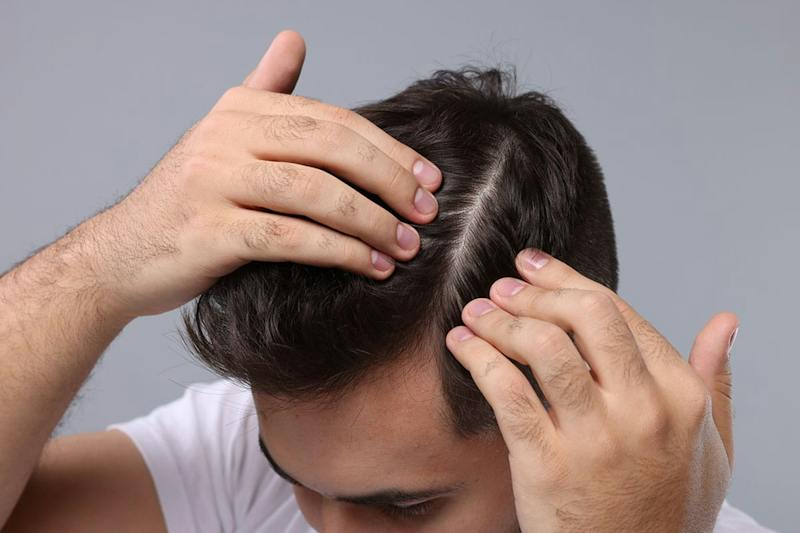
The hairline is the only part of the scalp where individual hairs are viewed in silhouette against bare skin, and silhouette exposes direction instantly. Behind the hairline, hair sits in a mass.
Mass forgives. A shaft that exits two or three degrees off its neighbors disappears into the bulk of everything around it. At the leading edge there's no bulk to hide in, so the eye picks up on the outline of each shaft against forehead skin and reads it, correctly, as either growing or planted.
Hair restoration is a significant part of what I do at my practice in Miami, FL, and the anterior hairline is where I spend a disproportionate amount of my operative attention relative to its square footage. The temple points and the front two rows of the frontal tuft take more of my time than the entire mid-scalp.
That ratio is intentional. The rest of the scalp needs coverage. The hairline needs choreography.

What Is the Angle of Emergence?
The angle of emergence is the angle a hair shaft makes with the skin surface as it leaves the scalp, measured in two planes at once: its pitch relative to the scalp and its compass direction across it. At the central frontal hairline, I cut sites close to twenty degrees off the skin, forward and slightly downward, which is flatter than most people expect and flatter than most beginners are comfortable making a blade sit.
The reason is mechanical. A hair leaving the scalp at twenty degrees lies across the forehead and casts a shadow line. A hair leaving at sixty degrees stands up, catches light on its shaft, and separates visually from the hairs beside it. Even if the follicle count is identical, the steeper hairline looks thinner, because standing hairs don't overlap each other.
Research on aesthetic indicators in hair transplantation confirms that exit angle is one of the primary variables the eye uses to judge naturalness.
Pitch is also what controls how the hair behaves once it reaches combing length. Direction set at the site determines where the hair goes at four inches, not just at four millimeters.
Reading Hair Caliber Before Anything Else
Fine hair punishes angle errors far more than coarse hair does. A patient with high-caliber Hispanic or Middle Eastern hair has shafts thick enough to create their own visual density, which means a few degrees of error gets absorbed.
A patient with fine, light-colored hair has nothing to absorb it. Every shaft in the front row is doing individual work, and one that stands up where its neighbors lie flat is immediately visible in a bathroom mirror.
So I start with caliber, curl, and color contrast against scalp before I start talking about graft numbers. I also map miniaturization.
The hairline is rarely a clean line; it's a transition zone of progressively thinner native hairs, and those existing miniaturized hairs already have an angle. If I cut sites that disagree with them, the result is two hair populations growing at cross purposes until the native ones shed, and then the planted ones look like a stencil.
Scalp laxity and existing scar tissue change blade depth, not just angle, which is a related but separate problem relevant to managing hair transplant scars in revision cases.
Slits or Needles for Recipient Sites?
I use lateral slits cut with blades sized to each graft, not round needle punctures, for the anterior hairline. A slit holds a graft in a plane.
A round hole lets a graft rotate, and a rotated follicular unit with two or three hairs fans in a direction nobody planned. Lateral orientation also lets grafts sit shoulder to shoulder without crowding their blood supply, which is how I get coverage without stacking.
Depth is matched to graft length within a fraction of a millimeter. Too shallow and the graft pops during insertion. Too deep and you get pitting, which reads as texture even when the angle is perfect.
Except when the patient has had prior work. Then the recipient bed is scarred, the dermis is stiff, and a blade that behaved predictably in virgin scalp skates. In those cases, I slow down, cut fewer sites per pass, and accept that I will place less density in exchange for holding direction. Studies on unfavorable hair transplant revision document exactly this tradeoff between density and directional control in scarred tissue.
A patient last year came to me with a hairline placed elsewhere, grafts emerging nearly perpendicular across the central third and almost no temple definition. I didn't add density to the front at first.
I cut new sites at roughly eighteen degrees interleaved between the old ones, using single-hair grafts only for the leading two rows, and placed them with jeweler's forceps under magnification so each graft seated in the plane of the slit rather than rolling. The old steep hairs were left alone to be camouflaged rather than excised. At twelve months, the hairline lay forward as a single population, and the perpendicular hairs were no longer findable in photographs.
If the angle is wrong, adding grafts makes it worse. You aren't filling a gap. You're doubling the number of hairs pointed in the wrong direction.
Where Recipient-Site Angle Matters Most
The temporal region is where recipient-site angle matters more than anywhere else on the head, because the required angle is nearly flat against the skin and the margin for error is almost zero. Temple hairs point downward and posteriorly, hugging the scalp. Place them even slightly upright, and the patient gets a strip of fuzz that looks pinned on.
The principles behind natural hairline aesthetics apply here regardless of whether the patient is being treated for recession or lowering.
Zone | Direction | Pitch against scalp
- Central frontal tuft | Forward, slightly down | Very acute
- Lateral hairline | Forward and slightly outward | Acute
- Frontotemporal recess | Transitional, fanning laterally | Acute, flattening
- Temple point | Downward, swept backward | Nearly flat

The caliber question from earlier comes back here, because temple hair in most patients is finer than frontal hair, and I will often split follicular units to get single-hair grafts for that zone even when the patient has plenty of donor supply.
Whorls and cowlicks at the frontotemporal junction get followed, not corrected. I spend part of every hairline design session with a comb and a wet scalp, finding the native swirl pattern and marking it, because a cowlick rebuilt against its own direction never settles. Published data on hairline asymmetry reinforces why mapping these patterns before any incision is made is non-negotiable.
Feathering the Leading Edge
Density at the very front should be lower than the density three millimeters behind it, and this is where I think surgeons disagree most. I use single-hair grafts across the leading rows, placed irregularly, with deliberate gaps. I will admit my own aesthetic here runs more conservative than some colleagues, and I have gone back and forth on how irregular to make the border.
Early on, I built hairlines straighter than I do now. I also used to place sentinel hairs further forward than I currently do, and I am not entirely sure the current version is better in every face, just better in most of the ones I see. Younger patients especially.
What I won't do is build a solid line. A hairline with a crisp edge looks constructed at any density, and it ages badly as the hair behind it recedes around it. Patients researching common hair transplant myths often arrive expecting a dense, defined front row, and part of my consultation is explaining why that expectation works against them.
What the Numbers Look Like in My Practice
Roughly seventy percent of my practice is concentrated in two areas, facial plastic surgery and hair restoration, which is unusual and intentional. I am double board-certified by the American Board of Facial Plastic and Reconstructive Surgery and the American Board of Otolaryngology, completed fellowship training in facial plastic surgery at the University of Illinois-Chicago, and have published more than 26 peer-reviewed articles.
I also hold a faculty appointment as Clinical Voluntary Assistant Professor at Florida International University Herbert Wertheim College of Medicine. My hair restoration work is built around the Foundation Aesthetic Hair Restoration Method in partnership with Dr. Jeffrey Epstein.
I am not going to cover donor-area harvesting technique here, FUE versus strip, punch sizing, any of it, because that's a separate decision tree and it has nothing to do with what the hairline looks like once the grafts are in. Angle is a recipient-side problem.
How Long Until Grafts Lock In?
Grafts are held by fibrin, not sutures. For the first seventy-two hours, that clot is the only thing keeping the angle you paid for. Friction dislodges grafts.
So does a hat brim riding the hairline, which is why I ask patients to leave hats off the frontal zone for the first two weeks even after the scabs clear. Following successful hair transplant healing protocols during this window is what preserves the directional work done in surgery.
Scabs lift on their own by approximately the tenth day. Don't pick them. Picking pulls the graft, and a graft pulled halfway out reseats at whatever angle it lands in.
The worst habit I see in hair transplant recovery is the patient who starts combing the new hairline forward at day five to see how it will look. You aren't previewing the result. You're rotating grafts in soft tissue.
Shedding and the Twelve-Month Mark
Transplanted hairs shed within the first month. That's expected. Regrowth starts around three to four months, and the hair that comes in is often wiry and misbehaves for a while before the process takes on the character of surrounding hair.
The real assessment happens at twelve months, sometimes later in the temples. When comparing hair transplant results across surgeons, twelve-month photos shot in natural light are the only honest benchmark.
Why I Hand-Place the Front Row
I make every recipient site in the anterior hairline myself, by hand, under magnification. No automated system cuts those rows in my operating room. Machines are efficient at coverage and poor at intention, and the frontal hairline is almost entirely intention: a cowlick that veers at the right frontotemporal recess, a patient who parts on the left and needs the sweep built accordingly, a slightly asymmetric temple point that matches the asymmetry already in the face.
The common belief that ethnic hairlines need fewer grafts and a conservative, uniform design is backwards. They need more individualized direction, not less, because curl and caliber amplify any directional error.
"If I had to choose between adding five hundred grafts and getting the front two rows aimed correctly, I would take the angle every time."
When you evaluate anyone's work, including mine, three things are worth checking:
Ask directly whether the surgeon or a technician cuts the recipient sites in the front two rows. If the answer takes more than one sentence, it's a technician. Ask for wet-combed photos. Nearly every gallery image online is styled and dry, and styling hides a steep angle beautifully. Look at results at twelve months and later, not at six.
The thing is, you can see angle in a photograph if you know to look for the shadow the hair casts on the forehead. Flat hair casts a line. Standing hair doesn't.
Planning Your Hairline in Miami
If you want a dramatic change visible by summer, I am not the right surgeon for you. Hairlines take a year, to tell the truth. If you're willing to wait for hair that exits the scalp the way it did before you lost it, come see me in Miami, FL, and I will do a hairline design assessment: donor evaluation, caliber and curl mapping, and a drawn frontal silhouette on your own scalp before anything is scheduled.
Frequently Asked Questions
Why do hairline grafts need to be placed at a flatter angle than grafts in the rest of the scalp?
Hairline grafts require a flatter angle because the leading edge of the hairline is viewed in silhouette against bare forehead skin, where every shaft's direction is individually visible. Behind the hairline, surrounding hair mass conceals minor angle variations. At the anterior hairline, a graft exiting at a steep angle stands upright, catches light along its shaft, and visually separates from neighboring hairs, making the hairline read as thin or artificial even when follicle counts are adequate.
Does hair texture affect how precisely the angle has to be set during a hairline transplant?
Fine, light-colored hair requires far more precise angle control than coarse, high-caliber hair. Coarse shafts generate enough individual visual density that small directional errors are partially absorbed. Fine hair has no such buffer: a single front-row graft pointing a few degrees upright while its neighbors lie flat is immediately visible in a mirror. Surgeons treating patients with fine or light hair must treat each shaft in the leading rows as doing independent optical work with no margin for angle drift.
What is a lateral slit technique and why do some surgeons prefer it over needle punctures for the hairline?
A lateral slit is a blade-cut recipient site shaped to match the width and length of a specific graft, holding it in a fixed plane. A round needle puncture leaves a circular hole that allows a multi-hair follicular unit to rotate after insertion, sending its hairs in an unplanned direction. At the hairline, where direction is the primary variable controlling naturalness, the inability of a round site to constrain rotation is a meaningful disadvantage that lateral slits avoid.
Can a hairline with grafts growing at the wrong angle be corrected without removing the original grafts?
A hairline with poorly angled grafts can be significantly improved without excision by interleaving new sites cut at the correct angle between existing grafts. Single-hair grafts placed in the leading two rows at the corrected angle, seated precisely in the plane of each slit under magnification, gradually camouflage the steep original hairs as the two populations grow together. Removing the original grafts is generally unnecessary and risks additional scarring; the goal is to surround and visually absorb the misdirected shafts rather than eliminate them.
Why is the temple area considered the most technically demanding region for recipient-site angle in hair restoration?
The temple region is the most technically demanding because native temple hairs grow nearly flat against the skin, pointing downward and posteriorly, leaving almost zero tolerance for upright placement. Even a small deviation toward vertical produces a visible strip of hair that appears separate from the scalp surface rather than emerging from it. The required angle at the temples is more acute than anywhere else on the head, and the contrast between correct and incorrect placement is immediately apparent at conversational distance.

Written by: Dr. Anthony Bared
Double board-certified in facial plastic and reconstructive surgery and otolaryngology; University of Miami-trained and fellowship-trained, with a practice limited exclusively to the face.
About Dr. Bared