


Most weeks, someone sits down across from me holding a phone photo of a nose that belongs to a face with completely different skin. I press on the tip, feel how dense and rubbery the tissue is over the lower lateral cartilages, and watch the expectation shift as I explain what that density actually does.
Thick skin changes rhinoplasty planning at the level of strategy, not execution: it muffles every millimeter of cartilage refinement underneath it, holds fluid far longer than thin skin, and demands a stronger internal scaffold just to show definition at all. At Dr. Anthony Bared Facial Plastic Surgery in Miami, that thirty seconds of palpation at the start of a consultation reshapes the surgical plan more than any reference photo ever does.
Two variables drive everything that follows: how much structural support the tip needs, and how long the skin envelope will take to contract over it. Everything else I discuss below is secondary, and I treat it that way.
How Thick Skin Changes Surgical Goals
Thick skin places a hard ceiling on tip definition, and that ceiling is predictable enough that I plan around it from the first visit. Skin behaves like a blanket draped over furniture.
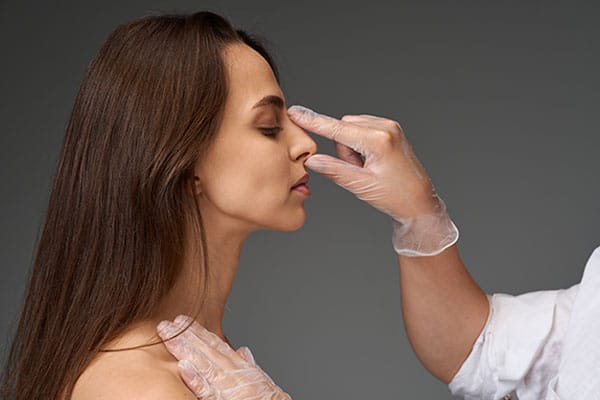
Thin skin drapes tightly and reveals every edge, every suture, every 1mm asymmetry in a cartilage graft. Thick sebaceous skin drapes like canvas. It rounds off contours, fills in the shadows that create the illusion of refinement, and absorbs small changes entirely.
That is why reduction alone fails in these patients. Take cartilage away from a thick-skinned tip, and the envelope simply collapses into the space you created, producing a blunter, rounder, less defined nose than the one the patient walked in with. The surgical goal shifts from removing bulk to building a frame the skin must conform to.
A thin-skinned patient asks me to be gentle. A thick-skinned patient needs me to be structural. Same operation, opposite logic.
Reading Sebaceous Skin at Consultation
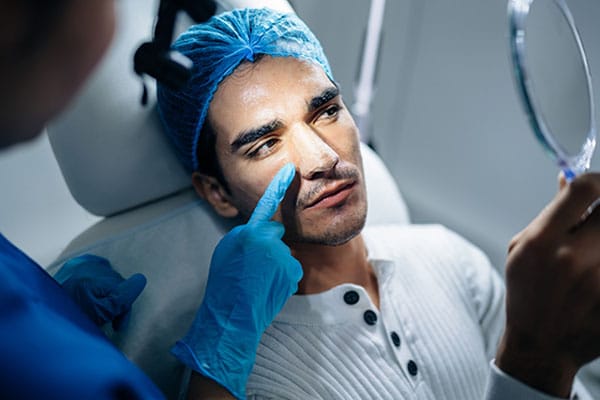
I grade skin by feel and by pore architecture, not by ethnicity and not by photographs. The specific finding that changes my plan is this: when I pinch the supratip between two fingers, does the skin fold cleanly over the cartilage, or does it move as a single unit with the structure beneath it? If it moves as a unit, sebaceous gland density is high, the subdermal layer is thick, and that patient is getting a structural plan regardless of what their reference photos show.
Pore size at the alar lobule tells me something about long-term scar response as well. Dense sebaceous skin lays down more supratip scar tissue in the months after surgery, which is the real reason definition arrives late in these patients rather than never.
I see this skin type across a wide range of patients, and it shows up frequently in the Hispanic, Asian, and African-American rhinoplasty patients I operate on in South Miami and Coral Gables. It isn't an ethnic feature. It's a dermal one.
Why Open Structure Rhinoplasty Wins Here
I use an open structure approach on essentially every thick-skinned tip, and I will not do a closed approach on one. The reason is visibility and fixation.
Thick skin contracts down over the tip like shrink wrap during healing, and that contraction generates real force. Grafts that aren't secured into a stable position under direct vision risk shifting under that force.
The cartilage work has to be, actually, let me back up. People hear "open" and think scar. The columellar incision in a well-planned rhinoplasty isn't the part of the operation worth worrying about. The part worth worrying about is whether the framework holds for twenty years.
If the tip cartilage is weak to begin with and you reduce it and close, that isn't a rhinoplasty. That is a scheduled revision with a delay built in.
Grafts That Hold Against Heavy Skin
The belief that thick-skinned noses need conservative, minimal work is backwards. They need more support than thin-skinned noses, not less.
My primary graft source is septal cartilage, which is straight, firm, and plentiful in a primary case. Except when it has already been harvested, or when it is deviated badly enough that the usable segment is small. Then I am looking at conchal cartilage from the ear, which is curved and softer, and that changes how I orient every piece.
A patient last year came in after a reduction rhinoplasty elsewhere with heavy sebaceous skin and a tip that had lost almost all projection. Her lower lateral cartilages had been thinned to the point of being flimsy, and the supratip had filled in with scar.
I harvested the remaining septal cartilage for a columellar strut and used conchal cartilage for lateral crural strut grafts, then placed a shield graft to push the tip-defining points forward against the weight of the envelope. The strut was fixed at the anterior nasal spine, where even small deviations from that landmark can alter tip rotation. At her fourteen-month visit, the supratip break had finally emerged, and the projection had held.
Suture technique matters as much as graft choice. I use interdomal and transdomal sutures to narrow the domes, but I set them tighter than I would in a thin-skinned patient, because the envelope will round off whatever I create by several degrees.
How Much Tip Fat Can I Remove?
Some, carefully, and the limit is vascular. I debulk the subcutaneous fibrofatty layer over the domes in thick-skinned patients, which genuinely improves definition. But the subdermal plexus supplies that skin, and thinning past it produces skin compromise, telangiectasias, or necrosis. Those aren't recoverable complications.
I will admit I go back and forth on how aggressive to be here. Earlier in my career, I defatted more than I do now, and I think some of those results were slightly over-thinned at the supratip.
Or maybe the edema just masked it, and I was wrong about the cause. What I settled on is conservative debulking plus strong structure, and I would not argue hard against a surgeon who does the opposite, as long as they're watching the plexus.
I will say this: the consultations I find most useful are the ones where the patient came in convinced the tip was the whole problem, and we discover that a weak chin is driving the perception of nasal size. That conversation redirects the entire plan.
Thick Skin Planning by the Numbers
My planning for these cases comes out of fellowship training in facial plastic surgery at the University of Illinois-Chicago, where open structure rhinoplasty was the core technique. I am certified by both the American Board of Facial Plastic and Reconstructive Surgery and the American Board of Otolaryngology, and I have published 26 or more peer-reviewed papers over the course of my career.
About 70 percent of my surgical practice is concentrated in two areas, rhinoplasty and hair restoration, which means these skin-type decisions come up constantly rather than occasionally. I also teach as a Clinical Voluntary Assistant Professor at Florida International University Herbert Wertheim College of Medicine.
Planning variable | Thin skin | Thick sebaceous skin
- Primary surgical goal | Controlled reduction | Structural support
- Graft visibility risk | High | Low
- Supratip edema duration | Months | Over a year
- Taping protocol | Brief | Extended
Numbers on the certification side are easy to verify. The numbers on the healing side are the ones patients care about, and those
What the First Six Weeks Look Like
Splint comes off on day seven. Bruising is mostly gone by the second week. Social downtime runs seven to fourteen days for most people, meaning you look normal to a coworker, not to yourself.
No exercise for six weeks. I mean it. Heart rate drives edema straight into the skin envelope, and in thick skin that fluid doesn't clear quickly.
Nose feels numb and stiff at the tip. Normal. Sensation returns slowly.
How Thick Skin Changes the Healing Curve
Thick skin holds postoperative edema for eighteen months. Not twelve.
Not "about a year." Eighteen months, and in some sebaceous skin types longer than that. The shrink-wrap force I described in the open structure section is the same process at a different timescale: the envelope is contracting the whole time, and definition emerges as fluid leaves and the skin tightens onto the framework.
Here's the odd part. Thick-skinned patients often like their result at six weeks more than thin-skinned patients do, because the swelling fills out the dorsum and the tip looks smooth. The refinement they actually asked for shows up around month ten and keeps improving through month eighteen.
I tape the supratip at night for the first several months in these cases. Taping doesn't reshape cartilage. It applies gentle sustained pressure to discourage supratip fluid from settling and scar from organizing in that dead space.
The single worst habit in thick-skin recovery is the daily mirror photograph. Swelling fluctuates with sleep, salt, and the weather, and a patient comparing Tuesday to Thursday will find a problem that doesn't exist. I have watched this habit turn satisfied patients into anxious ones in a matter of weeks.
Do Steroid Injections Actually Help?
Yes, in selected cases, and I use dilute triamcinolone for persistent supratip edema in thick-skinned patients who aren't resolving on schedule. The injection reduces fibrofatty thickening and discourages scar from accumulating in the supratip.
The risks are real and dose-dependent. Over-injection produces skin atrophy, visible vessel dilation, and depigmentation, and atrophy of that skin is difficult to reverse. I inject conservatively, space treatments out, and stop as soon as the contour responds.
Steroid is an adjunct to good structure. It will not rescue a tip that was built without adequate support, and I have seen that attempted.
Will the Tip Droop Over Time?
Gravity plus a heavy soft tissue envelope will pull an unsupported tip down, which is exactly why I anchor it. The columellar strut, fixed at the anterior nasal spine and sutured to the medial crura, functions as a post. Lateral crural support grafts resist the downward rotation that thick skin encourages over years.
A nose that loses projection at fifty usually lost it because nothing was holding it up at thirty-five. That is the collapse I plan against.
Patients who come to me for correction after a previous rhinoplasty frequently show this pattern: good early photos, progressive loss of tip definition and projection, and a surgeon who treated thick skin as a cosmetic nuisance rather than a mechanical load.
Planning a Nose That Ages Well
My priority is a result that still looks right in twenty years, which sometimes means refusing the degree of change a patient initially asks for. Overly narrowed tips and scooped dorsums photograph well at six months and collapse later. In thick skin, they also tend to look operated, because the envelope never settles onto an undersupported frame cleanly.
"A thick-skinned nose doesn't fail because the skin is thick. It fails because someone planned for thin skin and hoped the envelope would cooperate."
I am not going to argue the alloplastic implant question here, because dorsal implants in thick sebaceous skin are a long conversation about infection and extrusion risk that deserves its own article. What I will say is that autologous cartilage is what I use.
Not perfection. Harmony.
Frequently Asked Questions
Does thick skin mean I cannot get a defined nose after rhinoplasty?
Thick skin limits but does not eliminate tip definition after rhinoplasty. The upper boundary of refinement is lower than it would be for thin-skinned patients, but surgeons who account for that ceiling early by building a stronger internal cartilage scaffold rather than relying on reduction can achieve meaningful, lasting definition. The critical factor is that the framework must be rigid enough to resist the contraction force the skin generates during healing, which is substantial in sebaceous skin types.
How long does it take to see final rhinoplasty results with thick skin?
Patients with thick, sebaceous skin typically see final tip definition later than thin-skinned patients because dense skin holds postoperative fluid longer and lays down more supratip scar tissue before that tissue matures and softens. A supratip break or sharper tip-defining points may not fully emerge until twelve to fourteen months after surgery, compared to six to nine months for thinner skin types. Swelling at the three-month mark is not a reliable indicator of the final outcome in this skin category.
What cartilage grafts are used most often in rhinoplasty for thick skin?
Septal cartilage is the first-choice graft material for thick-skinned rhinoplasty because it is straight, firm, and available in useful quantities during a primary case. When septal cartilage is insufficient, conchal cartilage harvested from the ear serves as a secondary source, though its natural curve requires careful orientation of each piece. Common graft types include a columellar strut anchored at the anterior nasal spine, lateral crural strut grafts, and a shield graft positioned to push the tip-defining points forward against the weight of the skin envelope.
Why does reduction rhinoplasty alone fail on thick-skinned noses?
Removing cartilage without adding structural support in a thick-skinned nose causes the skin envelope to collapse inward rather than drape over a refined shape, producing a blunter and less projected tip than existed before surgery. Thick skin lacks the elasticity to retract and conform tightly the way thinner skin does, so the space created by reduction simply fills with envelope rather than revealing underlying contour. Surgeons experienced with this anatomy treat thick-skinned rhinoplasty as a structural problem requiring grafts and precise suturing, not a subtraction problem requiring only tissue removal.
Consulting on Your Nasal Anatomy
If you want a dramatically pinched tip and your skin will not permit one, I will tell you that in the first fifteen minutes rather than find out together a year later. Bring your reference photos anyway.
I want to compare them against what I feel when I palpate your tip. Schedule a consultation with me at Dr. Anthony Bared Facial Plastic Surgery in Miami, FL, at (305) 666-1774, and you will leave with a written anatomic assessment of how your specific skin thickness changes what your surgery can deliver.

Written by: Dr. Anthony Bared
Double board-certified in facial plastic and reconstructive surgery and otolaryngology; University of Miami-trained and fellowship-trained, with a practice limited exclusively to the face.
About Dr. Bared