

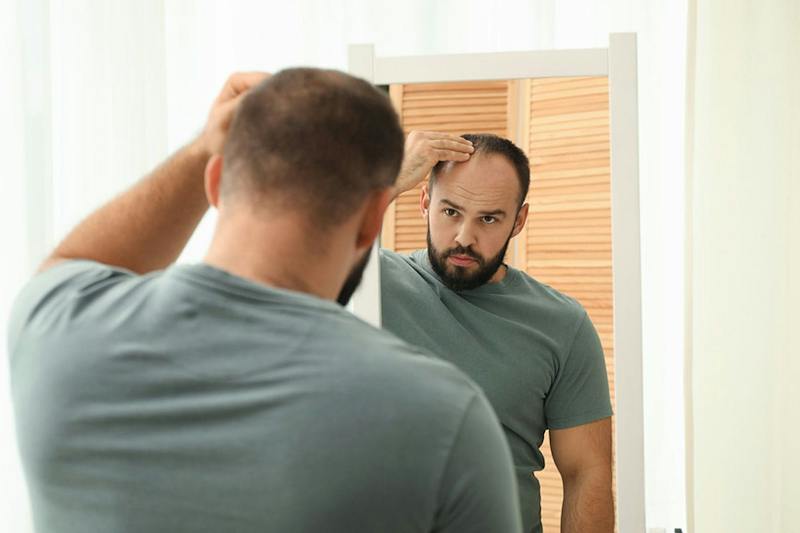
Most of the men who sit down across from me bring a photo on their phone, and it is almost never a photo of what they want. It's usually a stranger at a wedding, four rows back, with that stiff front row catching the flash. They point at it and say,"Not that."
What causes unnatural hair transplant results is almost never the device used to harvest or the number of grafts on the invoice. It's design and angulation: a hairline drawn in the wrong place for the face it sits on, follicular units set at angles that argue with the hair around them, and a frontal border built as a line instead of a zone. I have been doing this work at Dr. Anthony Bared Facial Plastic Surgery long enough to know those three decisions carry the result.
What Causes Unnatural Hair Transplant Results
An unnatural hair transplant is a restoration whose geometry gives it away before its density ever does. Hairline position and graft angle account for more fake-looking results than everything else in this article put together. Everything else (graft count, instrument choice, how slick the clinic's before-and-after gallery looks) is secondary to those two.

The human eye is unreasonably good at reading hair. It doesn't count follicles. It reads edges, light, and direction. A scalp with modest density but correct angulation looks like hair. A scalp packed with grafts that all exit at the same pitch looks like turf.
I am a facial plastic surgeon, double board-certified by the American Board of Facial Plastic and Reconstructive Surgery and the American Board of Otolaryngology, and I came to hair work through facial aesthetics rather than the other way around. That matters here.
A hairline is a facial feature. It frames the forehead the same way a brow frames an eye.
Hairline Position and Facial Proportion
The single most common design error I correct is a hairline placed too low and too far forward for a man who will keep losing hair. The classic teaching puts the mid-frontal point somewhere around 7 to 8 centimeters above the glabella on an average adult male face. I treat that as a ceiling, not a target, and in planning I usually move it back from there, not forward.
Why? Because donor hair is finite and loss is progressive. A hairline that flatters a 27-year-old becomes an island at 44 when the zone behind it thins out, and there's no reserve left to bridge it.
Patients push on this. They want the line they had in a college photo.
Recreating a teenage hairline on a mature face is not generosity; it is a design decision that will look wrong in both directions: wrong now because the proportion fights the forehead, and wrong in fifteen years because nothing is left to support it.
I also look at the curvature of the forehead in profile and at scalp laxity, because a convex forehead carries a hairline differently than a flat one.
Graft Placement That Causes Unnatural Hair Growth
Angle, direction, and exit point are the three variables I control at every recipient site, and getting any of them wrong causes unnatural hair growth patterns that no amount of density will hide. Angle is the pitch of the hair relative to the scalp surface.
Direction is where it points on the horizontal plane. Exit point is how the shaft breaks the skin.
At the frontal tuft, the hair lies forward and nearly flat against the scalp. Behind it, the pitch steepens. Laterally, the direction fans and then reverses as you move toward the crown whorl. These are not decorative details. They're the reason a native scalp reflects light unevenly and a transplanted one sometimes reflects it like a brush.
I use the FUE approach for harvest, but the extraction method is not what determines whether the result passes. Site creation does. I make the recipient sites myself, and I make them before anything is placed, so the architecture exists before the grafts do.
A quick qualifier: site depth has to match graft length, except when the skin is thick and sebaceous, which happens often enough in Miami, FL that I check it every time. Too shallow and the graft sits proud. Too deep and you get pitting.
The Transition Zone at the Front
The first two rows of a hairline should contain only single-hair follicular units, placed irregularly, never in a row. A natural hairline is not a line. It's a zone of sentinel hairs scattered forward of a soft, slightly ragged border, with small macro-irregularities (the little peaks and recessions) built in on purpose.
I will not put a multi-hair graft in the front two rows. If one gets there, it catches light like a fence post, and the patient will see it every morning for the rest of his life.
A patient last year came to me after a procedure elsewhere had left him with a flat, perfectly straight frontal border and visible two- and three-hair tufts along it. His donor area was still reasonable, but the front read as artificial from across a room.
I excised the offending multi-hair grafts along the border in a staggered pattern rather than all at once, redistributed those follicles higher into the frontal tuft, and rebuilt the transition zone with single hairs angled forward and slightly medial, breaking the line into three soft irregularities. At eleven months, the border had softened enough that he stopped combing hair forward to hide it. That was the actual outcome measure he cared about, not graft count.
I will say this: the cases that stay with me are not the dramatic ones. They're the men who tell me a year later that nobody noticed anything, which is the strangest compliment in medicine.
Temple Points and Frontotemporal Angles
Temple reconstruction is where I see otherwise competent work fall apart. The frontotemporal recession point should sit on a vertical dropped from the lateral canthus, and if it drifts even a few millimeters lateral to that, the whole front reads as a wig line.
Temple hair is also finer and lies at an extremely acute, downward and posterior angle. Place it at the pitch you would use at the mid-scalp, and it stands away from the skin. I rebuild temples cautiously, and sometimes I tell a patient his donor supply is better spent elsewhere.
Donor Area Over-Harvesting and Visible Scarring
Over-harvesting the donor zone is the most permanent mistake in this field, and it is the one patients discover last. The safe donor area is a band, not the whole back of the head, and it has a finite yield across a lifetime. Pull too aggressively from one session, and you get a moth-eaten look that shows under short clippers, which is precisely how many men wear their hair.
The failure mode here's predictable: a clinic quotes a very large graft number, harvests to hit it, and the back of the head pays for the front.

One more thing about the donor before I move on. Donor hair quality is not uniform. Caliber, curl, and the number of hairs per follicular unit vary across the band, and I sort grafts accordingly, because a coarse three-hair unit belongs behind the frontal tuft and a fine single belongs at the border.
A fine, straight, dark hair on pale skin gives the least natural-looking coverage per graft. A coarser, wavier hair gives more. Contrast between hair and skin color matters more than most patients expect.
Hair Transplant Healing by the Numbers
Healing follows a predictable sequence, and most of the worry I field comes from patients who don't know where they are in it. The honest framing is that nothing visible happens for months, then everything does.
Phase | What is happening | What you see
- First week to ten days | Grafts anchoring, crusts forming | Visible crusting, redness, donor soreness
- Weeks three to six | Transplanted shafts shed, shock loss of native hair | Scalp can look thinner than before surgery
- Around month four | Follicles re-enter growth phase | First fine sprouts, uneven
- Months eight to twelve | Caliber thickens, density fills | Result becomes socially obvious
- Twelve to eighteen months | Maturation, texture blending | Final character of the hairline
I ask patients to avoid vigorous exercise for the first three to four weeks. Light desk work usually resumes within a week. Social downtime is dictated by crusting and donor redness, not by how you feel.
How Long Before It Looks Natural?
Plan on twelve to eighteen months before the result looks like it belongs to you. Early growth at month four is thin, wispy, and frequently uneven across the scalp, which is normal and which almost nobody is prepared for.
Shock loss gets its own warning in my consultations because it frightens people more than anything else on this list. Native hairs around the grafts shed somewhere in weeks three through six. The scalp temporarily looks worse. Most patients recover fully, though in some, particularly those with already-miniaturized hairs, shock loss can be prolonged or permanent.
The worst habit after a transplant is parting the hair in the mirror every morning at month three to count sprouts. You will find almost nothing, conclude the surgery failed, and spend eight weeks miserable for no reason. Put the mirror down until month six.
I am not going to spend this article on finasteride and minoxidil dosing. Medical therapy is a separate conversation about keeping what you have, and it doesn't explain why a transplanted hairline looks fake.
Common Misconceptions About Density
Density is an illusion created by distribution, not a number you buy. Patients ask why a scalp looks see-through after a transplant, and the answer is usually that coverage was spread thin across too large an area, or... Actually, let me back up and define what density means here.
Native hair grows at a certain number of follicular units per square centimeter. No transplant restores that. What a good one restores is the appearance of coverage, which depends on where the grafts went, how they angle, and how light passes through them.
Packing grafts as tightly as possible produces the opposite of what patients imagine. Too dense, too uniform, and you get a wall of hair with a visible edge.
"If I can tell where the hairline starts from across a restaurant, the design failed, no matter how many grafts went in."
The other persistent myth: that transplanted hair changes texture later. In most cases, it doesn't; transplanted hair generally follows the characteristics of the donor zone, which is why donor quality drives the plan. That said, texture and behavior can shift over time due to miniaturization, differences in scalp environment, or hormonal and medical factors.
Red Flags When Evaluating a Surgeon
A few things should stop you cold during a consultation:
The graft number is quoted before anyone has examined your donor density under magnification. You're shown results at six months and told they are final. They're not.
The surgeon doesn't make the recipient sites personally, or can't tell you who does. Nobody discusses what your hairline will need in fifteen years. The office can't show you a single result on a patient with your hair caliber and skin contrast, and tries to substitute a high-contrast case that photographs better under studio lighting.
For revision patients, I also want to see the operative report from the prior surgery if it exists. It rarely does, which means I am reading the scalp instead: scar pattern, remaining donor, and how the old grafts were angled.
I trained in facial plastic surgery at the University of Illinois-Chicago, teach as a Clinical Voluntary Assistant Professor at Florida International University Herbert Wertheim College of Medicine, and have published 26 or more peer-reviewed papers. None of that guarantees a result. It does mean I will tell you when your donor supply can't support what you're asking for.
If you want a dense, low, straight hairline restored in one session, I am not your surgeon, and you should know that before you book. If you want a design that still looks right when you're fifty, that's a different conversation.
At Dr. Anthony Bared Facial Plastic Surgery in Miami, FL, I will examine your donor band under magnification and give you a written hairline design plan with graft distribution by zone. Come in and we will map it.
Frequently Asked Questions
Why do hair transplants look fake even when the graft count is high?
High graft counts do not prevent unnatural results because density is not what the human eye reads first. The eye reads edges, light direction, and exit angles. When follicular units are implanted at a uniform pitch rather than at the varied angles native hair naturally grows, the scalp reflects light evenly, which reads as artificial regardless of how many grafts were placed. Incorrect hairline position compounds the problem, because a hairline drawn in the wrong location for the underlying facial proportions signals artificiality before a single graft's angle is even considered.
What makes a hairline look like a hair transplant from across a room?
A hairline reads as transplanted at a distance when its frontal border is a hard, straight line rather than a soft, irregular zone. Natural hairlines contain scattered single-hair sentinel follicles set irregularly ahead of a slightly ragged border, with small intentional peaks and recessions built into the edge. Multi-hair follicular units placed in the first two rows catch light the way a fence post does, creating a visible, geometric border that no styling can disguise. Staggering graft size so that only single-hair units occupy the front rows is the standard that prevents this outcome.
How does hairline placement affect whether a hair transplant looks natural long-term?
A hairline placed too far forward for a man who will continue losing hair becomes visually isolated as the zone behind it thins, and limited donor supply means there may be no grafts left to fill that gap. A commonly referenced anatomical guideline places the mid-frontal point roughly 7 to 8 centimeters above the glabella on an average adult male face, and conservative planning typically starts at or behind that point rather than below it. A hairline that flatters a patient at 27 can look like a disconnected strip at 44 if progressive loss was not accounted for during the original design.
Can a bad hair transplant be corrected, or is the damage permanent?
Most poor hair transplant results can be improved, though the extent of correction depends on how much usable donor hair remains and the specific nature of the original errors. Common corrective approaches include excising misplaced multi-hair grafts along the frontal border, redistributing those follicles to more appropriate zones, and rebuilding the transition zone with single-hair units angled to break up an artificial line. Staggering corrections across more than one session rather than removing all problem grafts at once reduces visible disruption during the repair process.

Written by: Dr. Anthony Bared
Double board-certified in facial plastic and reconstructive surgery and otolaryngology; University of Miami-trained and fellowship-trained, with a practice limited exclusively to the face.
About Dr. Bared